



Sciatica
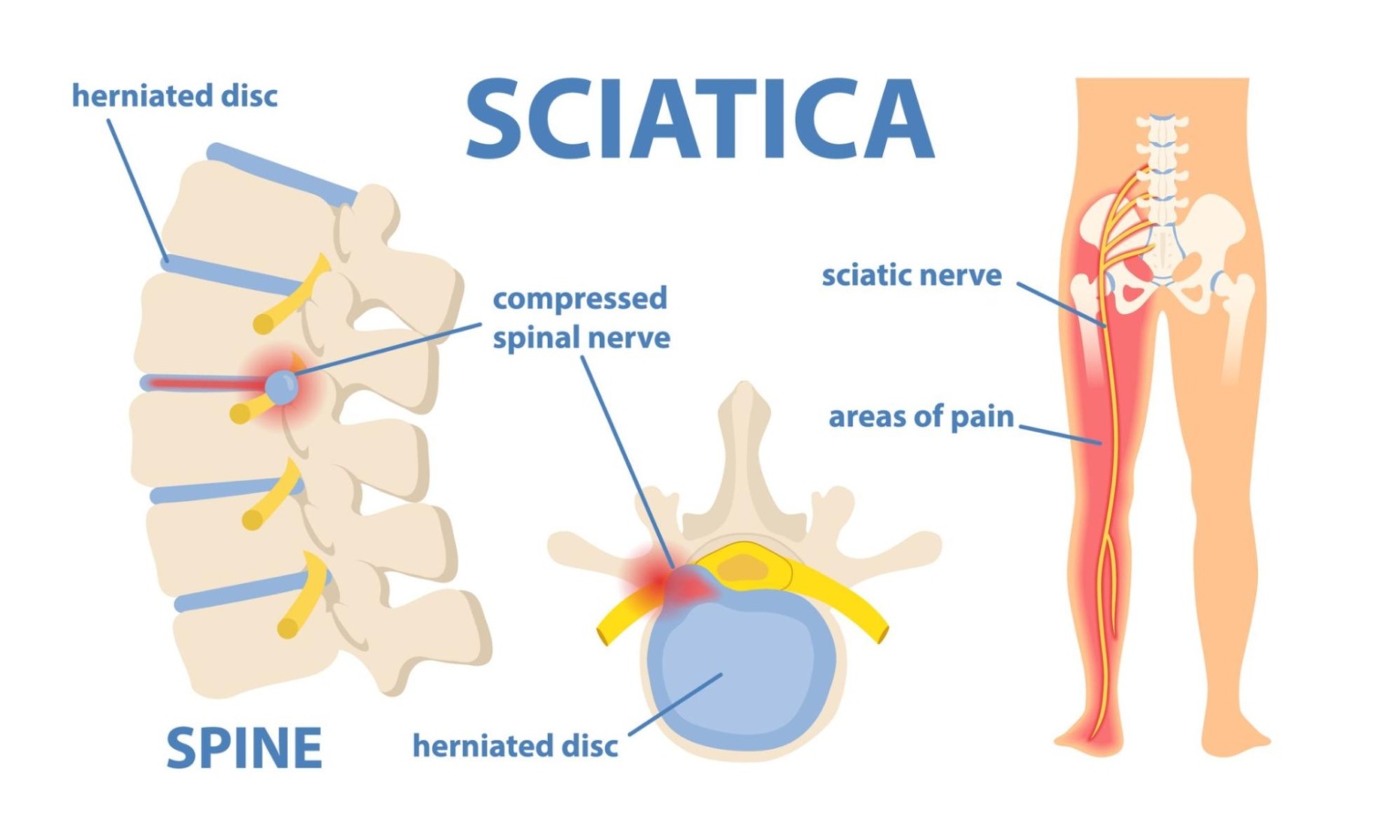
Sciatica commonly manifests itself as pain down the leg. And if you’re reading this, there is a good chance you know all about it. Sciatica takes its name from the sciatic nerve, which has its roots in your lumbar (lower) spine, runs down through your thigh, into the leg and foot. Sciatica strikes when the sciatic nerve is irritated or aggravated, which can cause local pain as well as referred pain down the entire leg.
The sciatic nerve originates as five nerve roots exiting the lumbar spine. Its construction is analogous to the fingers and forearm, where the nerve roots that exit from the spinal cord are like your fingers and the nerve itself, where the roots form together, is like your forearm. As the sciatic nerve makes its way down the thigh, lower leg and into the foot, smaller nerves branch off, supplying messages to joints, muscles, ligaments and other soft tissue structures.
People with sciatica may experience a myriad of different signs and symptoms. Some may feel a local pain in the buttock or low back. Others may experience a sharp pain in the low back and numbness and tingling down through the buttock, back of the thigh and into the lower leg and foot. If the cause is a disk herniation (a bulge or rupture in any of the disks that provide cushioning between spinal bones), the location of the pain will be specific — down the buttock, the back of the thigh, into the lower leg and in the big toe. This is called “radiating” pain. Pain arising from problems in the muscles or other tissues is more diffuse and broadly felt (in the whole foot, for example, rather than just the toe). This is called “referred” pain. Referred pain can manifest as pain down one or both legs and can even switch from one leg to the other without warning or reason.
Factors that commonly aggravate sciatic pain include sitting, straining on the toilet, coughing or sneezing. Generally, it is the twisting and bending-forward movements that are the worst. For that reason, activities like golf, tennis, hockey and running commonly exacerbate symptoms of sciatica.
Causes of Sciatica
Diagnosing the condition is not particularly difficult but determining its true cause can be tricky. The main reason is that there are five structures that can irritate or aggravate the sciatic nerve. The structures that can cause sciatica are 1) a disk herniation (neurogenic sciatica); 2) a tight muscle (myogenic sciatica); 3) an irritated joint (scleretogenous sciatica); 4) a narrowing of the space where the nerve roots exit the spine (neurogenic claudication, also known as intervertebral foraminal encroachment); and 5) a space-occupying lesion (any kind of growth, such as a tumor) impinging on the sciatic nerve. Fortunately, chiropractors have an expertise in differentiating between these different causes.
Bulging or herniated disks can cause compression on the nerve roots or initiate an inflammatory response that irritates nerve roots. See Disk Herniation in our database of Neuromusculoskeletal Conditions for a complete discussion.
The joints of the lower back or pelvis, like the sacroiliac joints, are common causes of referred pain in the buttock and thigh. See Low Back Facet Syndrome.
The nerve roots that exit the spinal cord and form the sciatic nerve exit through little holes in the spine called intervertebral foramen (literally, holes between the vertebrae). Normally, the holes formed by the bony spine are big enough for the roots to exit through without difficulty. Sometimes, however, disease, trauma or arthritis causes the diameter of these holes to diminish. This decrease in space may cause a tightening around the nerve root, which can aggravate or irritate the nerve and cause sciatica. In some cases, the bony hole may have a spur or sharp bony structure that actually touches the nerve root, further aggravating the condition.
A space-occupying lesion refers to any growth that may be impinging on the spinal cord, nerve roots or peripheral nerves. Some of the causes of sciatica previously cited fall into this category (especially disk herniation or foraminal encroachment). However, there are other space-occupying lesions that can cause sciatica, including tumor growth, organ enlargement (from an underlying disease) or even severe scar tissue formation from previous surgeries. In addition, some women complain of sciatica after they receive an epidural during labor.
Once there is inflammation or irritation involving one of these structures, a person may feel a “hot fire” in the low back. It is important to determine the cause of the fire and, if safe, to put it out. Because it is possible that the underlying cause may remain even after the pain is alleviated, it is important to check with your chiropractor before returning to your daily activities. Even if you’re feeling better, he or she may recommend you continue to receive care