



Hip Pain
Hip and Buttock Conditions
Conditions include sciatica and muscle strain. Research shows that chiropractic care is an extremely safe and effective treatment for pain due to these ailments.
Hip & Buttock-area conditions are often interrelated, and there can sometimes be a domino effect of injuries. For example, tense low back muscles can contribute to tingling, burning or stabbing pain in the hips, buttocks, thighs and lower limbs. These symptoms may result from any one of several conditions collectively known as sciatica. They’re painful but finding the source can be somewhat challenging.
Your chiropractor is trained to identify and locate the muscles, nerves, ligaments, joints and other soft tissue structures that may be contributing to your condition. Care begins with a comprehensive history and a physical examination. Your chiropractor may next use adjustments or physiotherapeutic modalities, such as ultrasound. He or she can also give you advice on posture and exercises to promote healing and improve function. This will help prevent future injuries and allow your body to perform at its best.
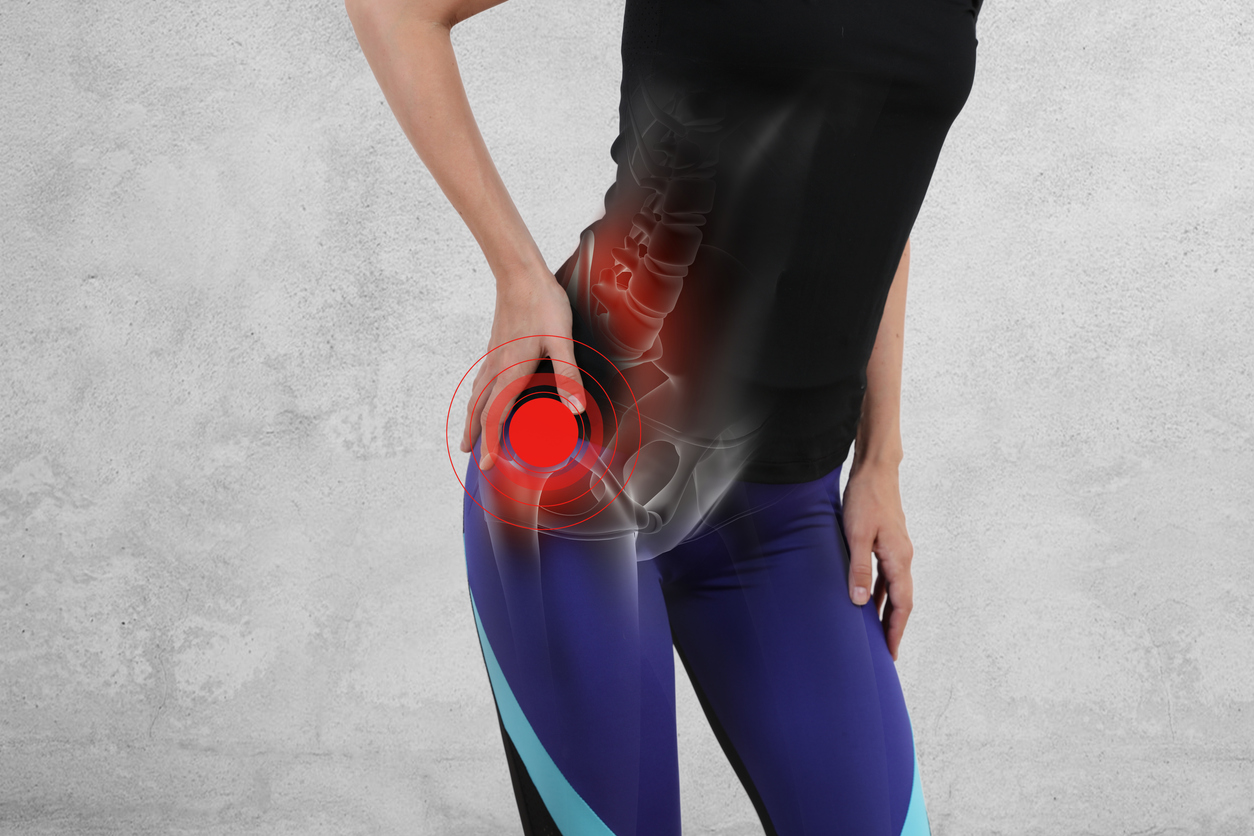
If you have been struggling with hip pain and aren’t sure where to turn for relief, a doctor of chiropractic may be your best solution to get to the root of your problem. The hip joint is not only the biggest joint in the body but it has a large range of motion as well, meaning it is very important that this joint is able to move correctly.
While many people know that chiropractors work on the different joints and vertebrae in the spine, these aren’t the only joints that they treat. Any joint in the body can be out of alignment, including the hip joint and it can cause serious pain, discomfort and limited range of motion.
Your chiropractor can help evaluate your hip joint and other joints around the hip to determine what may be causing your discomfort or limited mobility.
Common Conditions Chiropractors Treat in the Hip
Chiropractors can treat a number of conditions in the hip region. Before your chiropractor will adjust the area or recommend treatments or exercises, they will do a full examination and take a set of x-rays. In addition to x-raying the hip area, they will likely look at films of your entire spine to make sure other issues or misalignments aren’t causing the pain in the hip area.
Here are some of the most common hip-related conditions that chiropractors treat:
- Subluxations
- Osteoarthritis
- Dysplasia
- Irritable Hip Syndrome
- Trochanteric Bursitis
- Sprain or Strain in the Hip
- Rheumatoid Arthritis
- Sciatic or Piriformis Syndrome
- Hip Bursitis
- Anterior Pelvic Tilt
- Tight Hip Flexor
- And more
If you aren’t sure what the condition is causing your hip pain, your doctor of chiropractic can diagnose the problem. You do not need a referral or a diagnosis to see a chiropractor, like you would from a physical therapist, so it is OK to make an appointment if you aren’t sure what the issue is.
All About Misaligned Hips
There are many patients who simply have a misalignment in the hip joint causing their pain and discomfort. When your hips are out of alignment, it won’t just cause pain and soreness in the hip joint area, it can cause pain in other areas of the body as well.
When a big joint like the hip joint is out of alignment, the rest of your body may start to compensate for the misalignment and it can cause even more pain in your back or your legs. Think about when you have a sore or strained ankle. After a few days of hobbling around, your “good” leg is going to start to feel sore from over compensating and carrying extra weight. The same thing can happen when your hip is out of alignment.
This is why it is so important to have your hips checked by a chiropractor. This non-invasive treatment can help get to the root of the issue causing your pain. After your full examination and x-rays, a doctor of chiropractic will be able to determine if chiropractic care is the right treatment for you, or if you need to be referred out to a different type of practitioner for care.
If you have more questions about hip pain and solutions that can work to help get you back to feeling like yourself, contact the doctors here at McAuliffe Chiropractic Office. You can book an appointment by calling us directly at (758) 518-5000 to make an appointment today.
If you have been struggling with hip pain and aren’t sure where to turn for relief, Dynamic Spine Center may be your best solution to get to the root of your problem. The hip joint is not only the biggest joint in the body but it has a large range of motion as well, meaning it is very important that this joint is able to move correctly.
While many people know that chiropractors work on the different joints and vertebrae in the spine, these aren’t the only joints that they treat. Any joint in the body can be out of alignment, including the hip joint and it can cause serious pain, discomfort and limited range of motion.
Dynamic Spine Center can help evaluate your hip joint and other joints around the hip to determine what may be causing your discomfort or limited mobility.
All About Misaligned Hips
There are many patients who simply have a misalignment in the hip joint causing their pain and discomfort. When your hips are out of alignment, it won’t just cause pain and soreness in the hip joint area, it can cause pain in other areas of the body as well.
When a big joint like the hip joint is out of alignment, the rest of your body may start to compensate for the misalignment and it can cause even more pain in your back or your legs. Think about when you have a sore or strained ankle. After a few days of hobbling around, you’re “good” leg is going to start to feel sore from over compensating and carrying extra weight. The same thing can happen when your hip is out of alignment.
This is why it is so important to have your hips checked. This non-invasive treatment can help get to the root of the issue causing your pain. After your full examination and x-rays, we will be able to determine if chiropractic care is the right treatment for you, or if you need to be referred out to a different type of practitioner for care.
If you have more questions about hip pain and solutions that can work to help get you back to feeling like yourself, contact the doctors here at Merritt Chiropractic Center. You can book an appointment by calling us directly at (758) 518-5000 to make an appointment today.
Body parts don’t give up when they’re overworked or tired, so much as they just keep working until they give out. The gluteus medius and minimus muscles in the hips and buttocks are no exception. When overworked, these muscles react by becoming tight, going into a constant state of contraction in order to perform their job, similar to a student staying awake all night to cram for an exam.
Eventually, however, the work catches up. They become exhausted and can’t perform as well or become limited in what they can do. When this happens, people can develop gluteus medius muscle syndrome or gluteus minimus muscle syndrome. Because the two muscles are so anatomically and functionally related, chiropractors often refer to either syndrome as gluteus medius/minimus muscle syndrome.
People with this syndrome often describe their pain as a deep, dull ache in the buttock that often radiates to other areas of the body. Rest or activity doesn’t determine the level of this pain, however. Instead, people with the syndrome often feel the most pain when they’re startled or make sudden movements.
A number of things can cause or contribute to tight gluteus medius or gluteus minimus muscles. Muscle imbalances, poor posture and poor spinal or foot mechanics can be a factor, as can anything that overworks the muscles. When overworked, the muscles develop minor strains, which causes an inflammatory response. This inflammation is what causes pain.
Because excess work can cause the syndrome, it’s very common among runners, who use these muscles extensively. But runners aren’t the only people susceptible, as generally anyone who is active and overuses their gluteus muscles can be affected. For this reason, it’s important for people with gluteus medius/minimus syndrome to avoid activities that put pressure on the gluteus muscles until their chiropractor says it’s okay.
But inactivity isn’t the answer either. To care for gluteus medius/minimus syndrome, your chiropractor will probably perform spinal manipulative therapy, which restores proper joint movement in the lumbar spine and sacroiliac joints, and trigger point therapy, which helps relieve tight muscles. Without rehabilitative exercises, however, these management techniques won’t be as effective, so it’s important to maintain a regular routine.
Piriformis syndrome is a common condition that develops when there is a chain reaction of nerve irritation in your low back, buttocks and legs. It begins with an aggravated or strained piriformis muscle, which is a muscle in each of your buttocks. That muscle, in turn, irritates small surrounding nerves, which then irritate the larger sciatic nerve that runs from your low back through your buttock and into your leg.
Commonly, patients with piriformis syndrome complain about a deep pain in a buttock but aren’t able to describe exactly where the pain is coming from. Sitting, climbing stairs or performing squats can make the bothersome pain even worse.
Because the sciatic nerve supplies nerve function to the leg, patients may also experience pain that moves to the outside of the thigh or even as far as the foot. For that reason, piriformis syndrome is classified as a type of sciatica, which is a category of conditions that cause tingling sensations, burning sensations, shooting pain, prickling and numbness along the lower limb.
When there’s no pain, people usually take piriformis muscles for granted, and don’t realize that they’re responsible for an extremely important movement: external hip rotation. To understand how the muscles work, picture a soccer player trying to kick or pass a ball with the inside of his foot. To perform this motion, he must rotate his leg about 80 degrees, so the foot is pointing outwards.
Without the piriformis muscle, this movement would be impossible. But a number of factors can interfere with the muscle, hindering performance and causing great pain. These include trauma to the sacroiliac joint (a joint in the pelvis that’s comprised of two bones: the sacrum and the ilium), sitting with one leg crossed over the other, having one leg that’s longer than the other, sitting or driving while one leg faces outward, improper walking, poor posture and faulty spine mechanics.
Hormones can also be a factor, and for that reason women are more prone to piriformis syndrome because they experience constant hormonal changes, such as those caused by menstruation, oral contraceptives, pregnancy and menopause. During pregnancy, for example, the body produces a hormone called relaxin to loosen ligaments around the pelvis in preparation for birth. The muscles around the pelvis, including the piriformis muscles, react by tightening up, forcing the piriformis muscles to work harder to stabilize the area.
With all these complications, and mostly because piriformis syndrome produces symptoms that are similar to other forms of sciatica, the condition can be very difficult to diagnose. Once a chiropractor determines the correct cause, however, he or she can provide effective care.
Ischial bursitis is a painful irritation in the buttocks, specifically around the ischia, which are the bony parts you can feel in each buttock when you sit down. Usually, fluid-filled sacs called bursae protect the ischia, cushioning movements between the muscles and bones in the area. With excessive use, however, friction on the bursa can make it inflamed and irritated.
The condition is quite literally a pain in the butt. Symptoms include soreness, tenderness and swelling in the lower buttocks, and patients often notice that this pain worsens with movement. The area may also feel warm to the touch, as heat often accompanies inflammation.
Ischial bursitis can affect anyone, at any age. Patients with the condition aren’t necessarily athletic or involved in physically demanding activities. Usually, they report sitting on hard surfaces for long periods of time, and some also report frequently riding horses. Injuries that involve trauma to the ischial bursae, like landing on the buttocks during a fall, can also cause the condition.
In physically active patients with ischial bursitis, the condition often develops after they perform activities that involve excessive contraction of the hamstrings (muscles at the back of the thighs), like running. These muscles can rub on the bursae, making them sore and irritated.
Regardless of the cause, however, conservative chiropractic care is effective for ischial bursitis. Your chiropractor will select from a wide variety of healing modalities that will help decrease pain, decrease inflammation and improve movement.
Low back pain is one of the most costly and disabling of all neuromusculoskeletal conditions, affecting over 80% of the population at some point. In fact, at any given moment 7% of adults are experiencing a spell of back pain that will last two weeks or longer.
Sacroiliac (SI) irritation is a specific form of back pain that affects the area in and around the dimples in the buttocks. Those suffering from SI irritation commonly experience sharp pain after straightening up from a stooped position, often while lifting an object. Twisting, leaning forward, bending backward and sitting for long periods of time can make the pain worse.
Abnormal movement in the sacroiliac joint, a joint comprising two bones, the sacrum and the ilium, generates this pain. You have two ilia and can feel them if you put your hands on your hips, just below your waist. The bony protrusions on either side are the ilia, which connect to the lower part of the spine, the sacrum. The connections between the bones are the sacroiliac joints.
Chiropractic studies estimate that these joints are responsible for about 10% to 30% of low back problems. Theories postulate that jamming of the joints, hormonal influences and arthritis are responsible, as these can lead to local inflammation and joint irritation that then lead to pain. Research also shows that lifting and bending makes patients more susceptible to SI irritation. This is particularly true for children, pregnant women and those with a degenerative disease.
Because SI irritation can develop into SI syndrome, a very similar, but more serious condition, it’s imperative that people see a chiropractor as soon as possible if they suspect they have it. Chiropractic care can provide effective management for the condition, as it can improve joint function and decrease pain
Sciatica commonly manifests itself as pain down the leg. And if you’re reading this, there is a good chance you know all about it. Sciatica takes its name from the sciatic nerve, which has its roots in your lumbar (lower) spine, runs down through your thigh, into the leg and foot. Sciatica strikes when the sciatic nerve is irritated or aggravated, which can cause local pain as well as referred pain down the entire leg.
The sciatic nerve originates as five nerve roots exiting the lumbar spine. Its construction is analogous to the fingers and forearm, where the nerve roots that exit from the spinal cord are like your fingers and the nerve itself, where the roots form together, is like your forearm. As the sciatic nerve makes its way down the thigh, lower leg and into the foot, smaller nerves branch off, supplying messages to joints, muscles, ligaments and other soft tissue structures.
People with sciatica may experience a myriad of different signs and symptoms. Some may feel a local pain in the buttock or low back. Others may experience a sharp pain in the low back and numbness and tingling down through the buttock, back of the thigh and into the lower leg and foot. If the cause is a disk herniation (a bulge or rupture in any of the disks that provide cushioning between spinal bones), the location of the pain will be specific — down the buttock, the back of the thigh, into the lower leg and in the big toe. This is called “radiating” pain. Pain arising from problems in the muscles or other tissues is more diffuse and broadly felt (in the whole foot, for example, rather than just the toe). This is called “referred” pain. Referred pain can manifest as pain down one or both legs and can even switch from one leg to the other without warning or reason.
Factors that commonly aggravate sciatic pain include sitting, straining on the toilet, coughing or sneezing. Generally, it is the twisting and bending-forward movements that are the worst. For that reason, activities like golf, tennis, hockey and running commonly exacerbate symptoms of sciatica.
Diagnosing the condition is not particularly difficult but determining its true cause can be tricky. The main reason is that there are five structures that can irritate or aggravate the sciatic nerve. The structures that can cause sciatica are 1) a disk herniation (neurogenic sciatica); 2) a tight muscle (myogenic sciatica); 3) an irritated joint (scleretogenous sciatica); 4) a narrowing of the space where the nerve roots exit the spine (neurogenic claudication, also known as intervertebral foraminal encroachment); and 5) a space-occupying lesion (any kind of growth, such as a tumor) impinging on the sciatic nerve. Fortunately, chiropractors have an expertise in differentiating between these different causes.
1. Disk herniations (neurogenic sciatica)
Bulging or herniated disks can cause compression on the nerve roots or initiate an inflammatory response that irritates nerve roots. See Disk Herniation in our database of Neuromusculoskeletal Conditions for a complete discussion.
2. Muscles (myogenic sciatica)
Tight piriformis and gluteus muscles can squeeze or put tension on the sciatic nerve. See Piriformis Syndrome or Gluteus Medius/Maximus Muscle Syndrome in our Neuromusculoskeletal Conditions section.
3. Joints (scleretogenous sciatica)
The joints of the lower back or pelvis, like the sacroiliac joints, are common causes of referred pain in the buttock and thigh. See Low Back Facet Syndrome.
4. Neurogenic claudication
The nerve roots that exit the spinal cord and form the sciatic nerve exit through little holes in the spine called intervertebral foramen (literally, holes between the vertebrae). Normally, the holes formed by the bony spine are big enough for the roots to exit through without difficulty. Sometimes, however, disease, trauma or arthritis causes the diameter of these holes to diminish. This decrease in space may cause a tightening around the nerve root, which can aggravate or irritate the nerve and cause sciatica. In some cases, the bony hole may have a spur or sharp bony structure that actually touches the nerve root, further aggravating the condition.
5. Space-occupying lesion
A space-occupying lesion refers to any growth that may be impinging on the spinal cord, nerve roots or peripheral nerves. Some of the causes of sciatica previously cited fall into this category (especially disk herniation or foraminal encroachment). However, there are other space-occupying lesions that can cause sciatica, including tumor growth, organ enlargement (from an underlying disease) or even severe scar tissue formation from previous surgeries. In addition, some women complain of sciatica after they receive an epidural during labor.
Once there is inflammation or irritation involving one of these structures, a person may feel a “hot fire” in the low back. It is important to determine the cause of the fire and, if safe, to put it out. Because it is possible that the underlying cause may remain even after the pain is alleviated, it is important to check with your chiropractor before returning to your daily activities. Even if you’re feeling better, he or she may recommend you continue to receive care