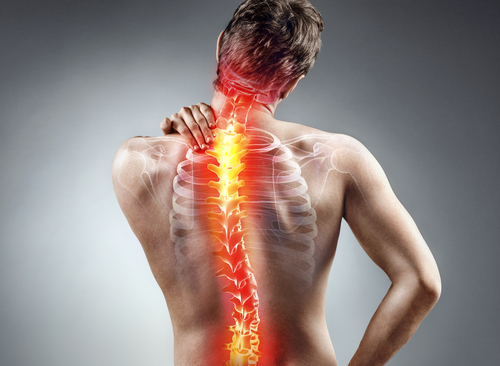



“Slipped disc” is a layman’s term commonly used to explain the condition with regards to the intervertebral disc in the spine (See Figure 1). Other terms associated with a slipped disc are also known as having a ‘disc bulge’, ‘disc herniation’ or ‘prolapsed disc’.

An intervertebral disc is located in between the vertebrae (hence its name) and it acts like a shock-absorber in the spine. When someone sustains an injury to their disc, be it due to degenerative changes, trauma, or any other pathologies of the disc, it tends to move and protrude outwards (imagine squeezing a jelly donut, see Figure 2), causing compression on the nerve that exits the spinal level.


There are four stages to a disc herniation and they commonly occur in the neck and low back.
Here are some of the common signs and symptoms of someone who might have a slipped disc:
- Neck pain/low back pain
- Numbness and tingling sensation to the arms and/or legs
- Weakness in arms and/or legs
- Bowel and/or bladder dysfunction (in severe cases)
- Saddle anaesthesia (in severe cases)
Q: Who gets slipped discs?
Slipped discs are most common in people aged (but not limited to) between 30 and 50. They affect twice as many men as women. Here at Spinefit, we have treated Practice Members as young as 19 years old and as old as 70 years old!
Q: How do I know if I may have a slipped disc?
If you have ever lifted something heavy from an awkward position and you experience a ‘snap’ or ‘popping’ sensation in the low back, followed by an intense sharp and shooting pain suddenly, it might be a good indicator that you might have had a slipped disc.
Poor posture when you sit or stand could place the disc under an excessive amount of stress. Other sudden movements like a simple sneeze or bending forward can trigger a slipped disc that can result with a sudden sharp and shooting pain as well.
Q: Can I prevent a slipped disc from occurring?
Yes! Some simple ways you can do to prevent a slipped disc from occurring would be to:
- Exercise regularly
Focus particularly on strengthening your core muscles as this will help with keeping your body in the right posture. - Using the correct lifting technique (See Figure 4)
Use your legs and not the back muscles. This is essential if you’re a weight-lifter and regularly include deadlifts as part of your gym routine. Focus on the correct lifting posture more than on the weights. - Take regular breaks in between work
If you can, it is advisable to move regularly throughout the work day. If you are desk bound, try to stand up and walk around every 45 minutes to an hour to get the body to move. It may seem like a loss in productivity, but in the long run, your body will thank you for it! - Stay hydrated
Your intervertebral disc depends on your body’s water content for its nutrients. This is why many health authorities recommend at least 2 litres of water intake daily. Alcohol and tobacco use is very dehydrating and excessive use can cause a higher likelihood of a slipped disc.
Self-Check:
If you suspect that you might have a slipped disc, here are some simple steps you can do to check if it results in any sharp or shooting pain. Try coughing forcefully and see if you feel any pain. Alternatively, you could attempt the Valsalva manoeuvre by closing your mouth, pinching your nose and attempting to forcefully exhale.
What these manoeuvre tries to do, is to increase the intrathecal pressure in the spine and protruding disc, so that it causes more compression on the nerve.
However, after doing this self-check, it is advised to still consult with a primary healthcare provider or make an appointment with us for further clarification and examination
A bulging disc is often thought of as a normal part of the aging process. It may causes pain and decrease mobility. Athletes and people who have very physical jobs are often prone to bulging discs as well as other disc issues. Not getting enough water and nourishment to the disc can also cause it to become weakened. Chiropractic has been proven to be an effective treatment for bulging disc and the associated pain.
A herniated disc is a relatively common condition that can occur anywhere along the spine, but most often affects the lower back or neck region. Herniated discs are typically caused by overuse injuries or trauma to the spine; however, disc conditions can also develop as a result of the normal aging process. It is also known that there is a genetic factor that contributes to the development of disc degeneration and herniated disc.